
Hello and welcome to Commander Bites!
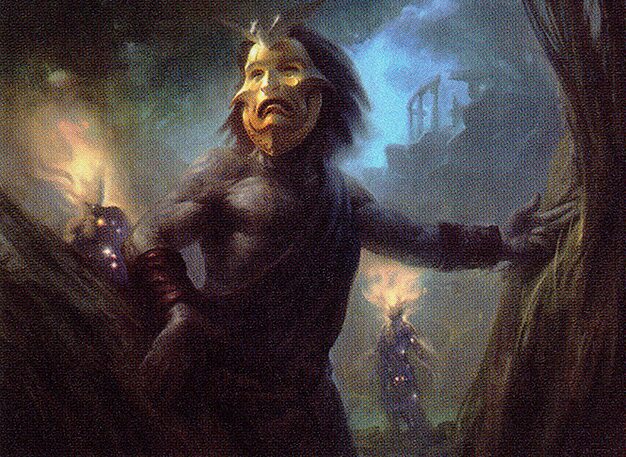
Today we are going to be talking about Lynde, Cheerful Tormentor!
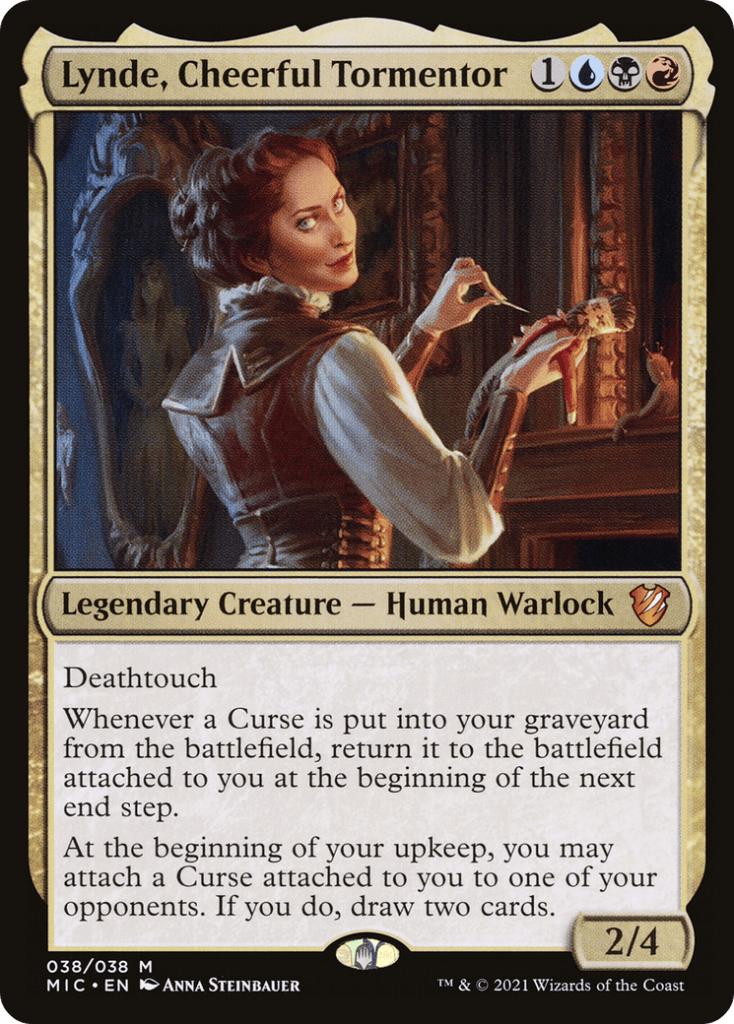
Lynde is a four mana 2/4 with deathtouch, whenever a Curse is put into your graveyard from the battlefield, return it to the battlefield attached to you at the beginning of the next end step, and at the beginning of your upkeep you may attach a Cure attached to you to one of your opponents and if you do, draw two cards.
Game Plan
Curses are a unique play space as far as enchantments go, and the fact that Lynde has an interesting interaction with the fact that Curses need to go into your graveyard from the battlefield so you can attach it to yourself to then attach it to someone else is definitely an interesting way to play with Curses.
The idea is that your opponent removes a Curse or loses the game, you gain all the Curse they had, and then attach a Curse to another opponent to draw two cards. Attaching Curses to your opponents can generate a good bit of advantage while keeping your opponents from attacking you, so there is some interesting potential for the deck.
Support
What we need to consider first is the variety of Curses that are available to us, and there are so many different kinds of Curses we can make use of.
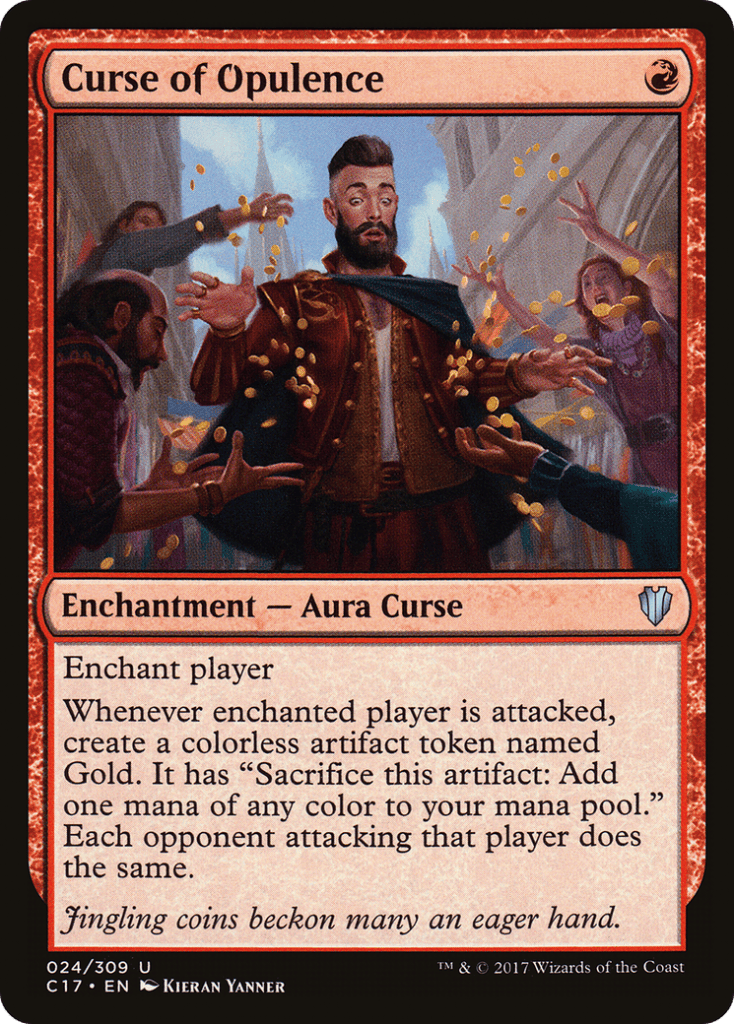
Curse of Opulence is a well known and well used Curse in being one mana to make it so that whenever the enchanted player is attacked you create a Gold token and each opponent attacking that player does the same, meaning that it incentivizes combat away from you for the promise of one mana.
Curse of Vengeance can also be a really solid early Curse to cast because whenever the enchanted player casts a spell, you put a spite counter on Curse of Vengeance and when the enchanted player loses the game you gain X life and draw X cards where X is the number of spite counters on the Curse, meaning that you can do a massive come back turn if you can gather enough counters on the Curse to potentially win the game.
Curse of Disturbance follows a similar idea, except that instead of a Gold token being made when the enchanted player is attacked, instead a 2/2 Zombie token is made, and much like the Gold token it can be a solid incentive to attack someone else so that the opponent makes a Zombie token and you make a Zombie as well.
Curse of Shaken Faith is an interesting Curse to use because it makes it so that whenever the enchanted player casts a spell other than the first spell they cast each turn or copies a spell, the Curse deals 2 damage to them. This means if you are playing against a spell slinger or Storm deck, this becomes a massive piece of tech against them and can even the playing field a little bit.
Curse of Misfortunes is also one of the more brutal Curses to play because at the beginning of your upkeep you may search your library for a Curse that doesn’t have the same name as a Curse attached to the enchanted player and then attach it to that player. This can be very useful to either tutor a Curse onto an opponent who is doing well or even if you attach it to yourself so you can tutor for Curses that you can then shift onto other players.
Maddening Hex is a fun Curse because whenever the enchanted player casts a noncreature spell, roll a d6 and then Maddening Hex deals damage to that player equal to the result and then you attach Maddening Hex to another one of your opponents chosen at random.
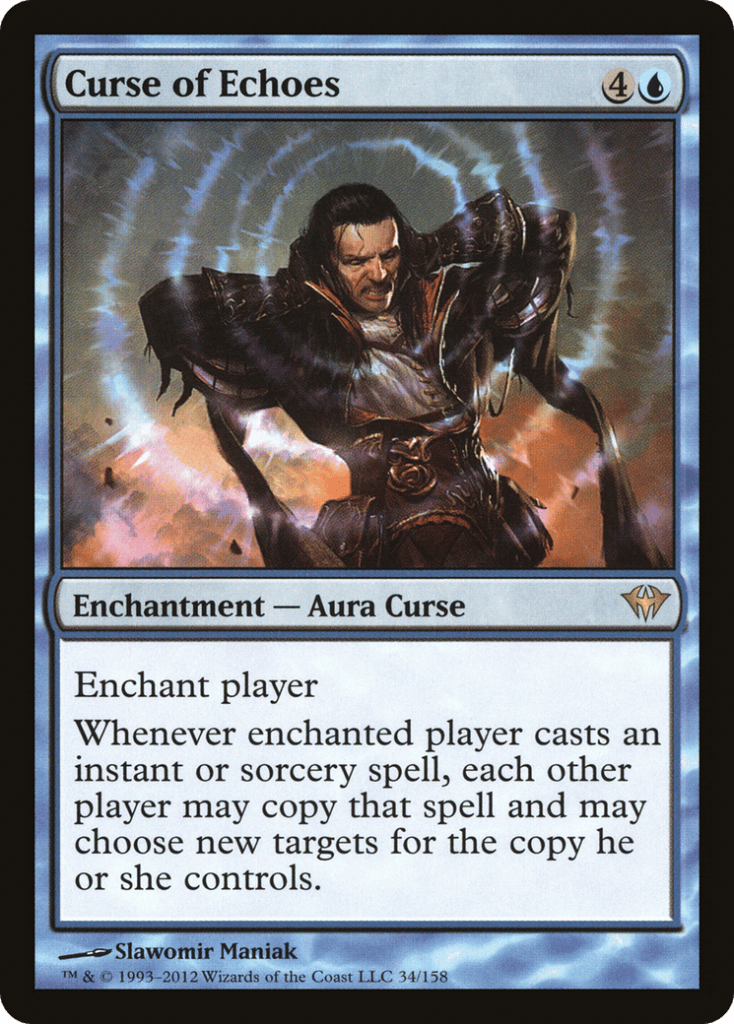
Curse of Echoes also works really well because whenever the enchanted player casts an instant or sorcery spell, each other player may copy that spell and choose new targets for the copy, which can be very helpful again to the spell slinger players, or even the control players to deal with potentially one sided board wipes to make them more even.
Setbacks
Playing an enchantment deck in our colors can be a bit tricky, since a lot of enchantment support tends to be in white and green.
We do have access to tutors in black as well as Curse specific tutors, however the other forms of enchantment support we have are much more general enchantment support with only a couple of Curse specific support.
What’s more, since we are dealing with enchantments we are playing a much slower control style of deck rather than a much more proactive deck. We do have access to ways of getting our Curses, but they need to remain on the field.
The other downside is pretty obvious, but for at least a turn we do have at least one Curse attached to us if one gets removed from the battlefield into our graveyard, which means that any effect that it has will be bad for us and incentivizes our opponents to attack us.
Not only that, but once it gets back to our turn we are going to move it to an opponent and draw two cards, which does further incentivizes our opponents into attacking us to prevent us from moving the Curse to one of them while also preventing us from drawing two cards.
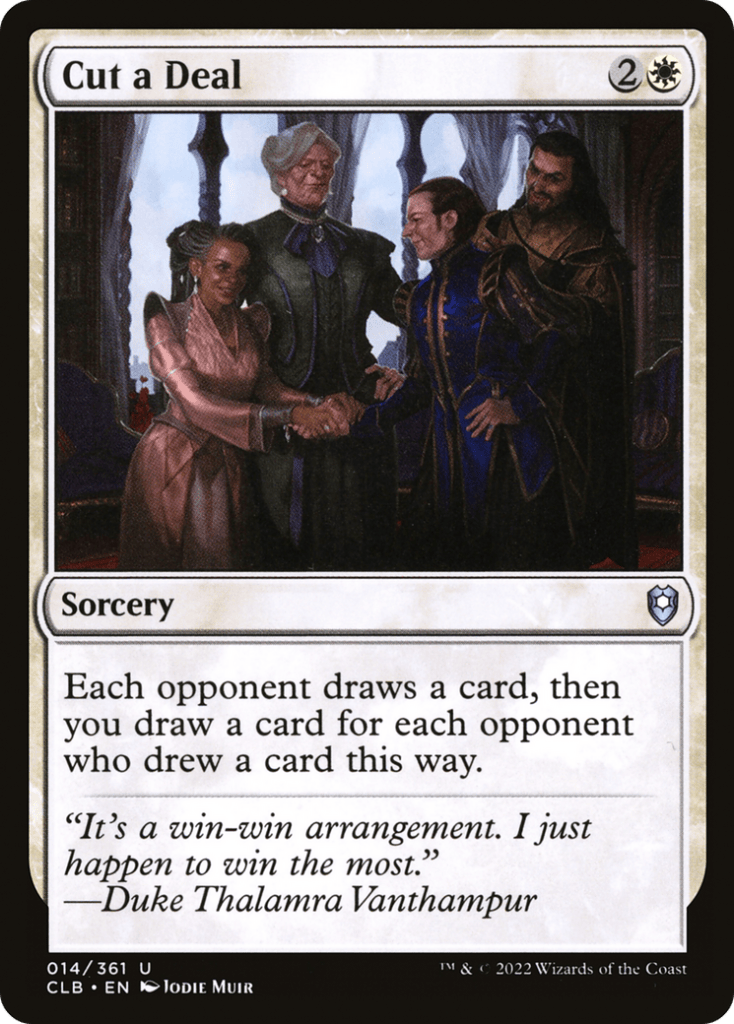
The deck can also be pretty table politics focused because you can choose who you Curse and make deals that are apropos to who you’re facing, but that also means that you need to be beholden to your deals more so than usual because the moment you break a deal or are looking like you are, your opponents will quickly move to attack you.
Bracket Rating: High 2, Mid 3
Lynde is an interesting Commander that has some interesting lines of play, but can be difficult to make work in higher levels of play.
The deck doesn’t operate fast enough to deal with some decks, but it can put up a decent fight in the long game if you are able to put enough Curses into play and can play into the politics a bit to make sure that you can get your Curses where you want them to be.
Thank you for reading, see you all tomorrow!
Peace,
From, J.M. Casual


Leave a Reply