Hello and welcome back to Magic Project: Omega!
We have returned to talk about some artifacts at Common, and this was one of the harder ones to get done. One, because I had some real life obligations to deal with, and two because I promised to make ten Common artifacts.
An issue I had with this is that ABU does not have any artifacts at Common, all of them were either Uncommon or Rare. So what I did was take a look at more modern sets and designed artifacts that would be solid at Common, while making homages to ABU Uncommon artifacts.
This was a tough one, but I managed to make it work in the end.
Let’s take a look!
Design Approach
So making ten Common artifacts first needed a plan of action in what I wanted to do.
I wanted to reference what artifacts I could from ABU while being generic enough to be used in any deck, with some potential outliers to help act as sort of a glue to other archetypes in the set.
I also decided that half of the artifacts were going to be artifact creatures to help give some more creatures that could fit in any deck and make them work effectively.
Looking at the creatures first, there were a couple of homages that I could make that would help establish my goal with the Common artifacts.
Some of the artifact creatures of the set were not quite creatures and acted more as artifacts that could become creatures, and I mitigated that by having them be actual creatures with abilities, with some of them mirroring their counterparts in ABU.
As far as the noncreature artifacts, this was actually a bit easier to do since there were some artifacts that could translate decently into being Common, with one or two straddling the line of Common and Uncommon.
I was surprised to see some artifacts in ABU being Uncommon because of how strong those Uncommons turned out to be, especially with one in particular.
Another thing that the artifacts share is that they have some pseudo mana sink abilities that some artifacts had in ABU, which are abilities that are more likely to change in the future.
Cards
Here’s what I came up with!





This was pretty difficult, one because of how difficult it was to make interesting cards, as well as making ten distinct cards.
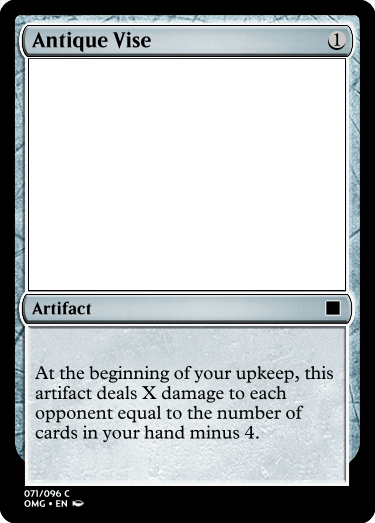
Starting with Antique Vise, this is very much another in the series of cards that go along with Black Vise in which hand size matters. Having something deal passive amounts of damage to your opponents is pretty strong, and it encourages you to have a lot of cards in your hand, which will be a bit of a difficulty.
Basalt Shard’s reference is pretty obvious, and I was pretty surprised to see Basalt Monolith as an Uncommon in ABU. I could have sworn it was in a later set, but my memory is a bit wonky with when cards were released. In any case a reference to Basalt Monolith at Common is teetering the line, but for now it seems to be ok.
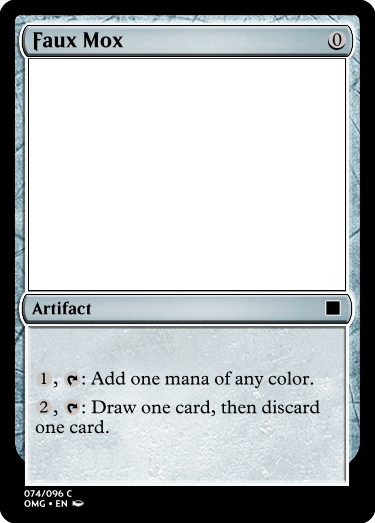
Faux Mox is more of a joke for me in the set, more so because I thought that it would be interesting to see if there could in fact be a Mox at Common that wouldn’t break the set. Having it be a way to filter your colors in the early game and then draw and discard you a card could be a way to add extra value to the card later in the game.
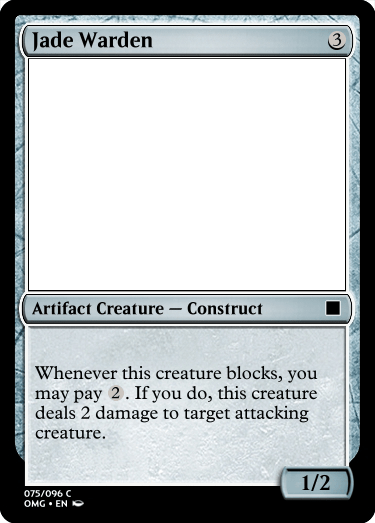
Jade Warden is the first of the artifact creatures and it serves to act as a bit of a deterrent to combat heavy decks. I do think that I could reduce the cost to deal the damage to one mana, but for now two mana will work as a middle point.
Juggernaut Gargant is another thing for me, as a someone who does enjoy the flavor of Juggernauts being a massive creature that must attack and can’t be stopped by Walls is fun. So I decided that making a massive Juggernaut that has haste would suffice as a mana expensive finisher.
Mana Focus is a reference to all the cards that were tied to a color and could have you pay one mana to gain a life if a spell of that color was cast. This consolidates them to one card while also evolving it to gain you more life the more colors the spell is, which doesn’t have mana pay offs yet, but will in the future.
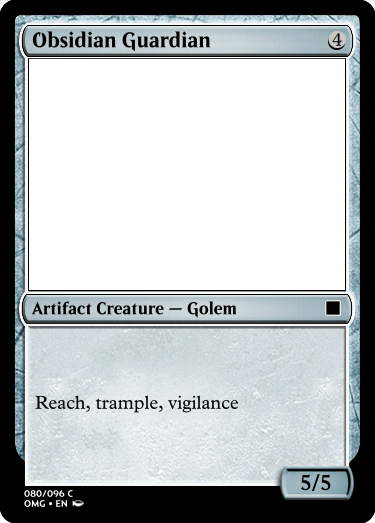
Obsidian Guardian is acting more as a solid creature that is above rate and was a bit of a botched reference to Obsianus Golem, which I initially read as Obsidian Golem. Reading the card, and such. In any case turning a below rate vanilla into an above rate French vanilla was nice to do. If anything I may change the name in the future.
Rusted Soldier is a cheap creature that is meant to be a bit of generic card advantage and life gain available to all decks. There wasn’t an explicit reference with this card, so I decided to be a bit more broad with what this card could do.
Shimmering Wall is more of a subtle reference to Living Wall, though this is much more obtuse. While Living Wall can regenerate, I thought that it would be more appropriate for a Wall to protect something, so having a Common creature function as a way to act as generic protection felt right.
Lastly there is Soul Strand, a reference to Soul Net, but instead of gaining you life like Soul Net does, I decided that having something that has an opponent lose life when a creature dies acted as a more interesting card idea. I did integrate the life gain as an ability that could help keep you stable for a turn. I did have it be a sorcery, though I do imagine that I could remove that for the future.
Overall I am feeling so so about these artifacts. They aren’t my best work, but I do think that there is potential in them. This is the category that I imagine will have the most changes in the future.
When we return to Magic Project: Omega, I am not quite sure where to go, but I’m sure I’ll figure something out when the time comes. I want to be a bit more open ended rather than setting some finite goals for this, at least for the moment.
Thank you for reading, see you all next time!
Peace,
From, J.M. Casual


 J.M. Casual Blog
Leave a comment