
Hello and welcome to Daily Commander!
Today we are going to be talking about Gwafa Hazid, Profiteer!
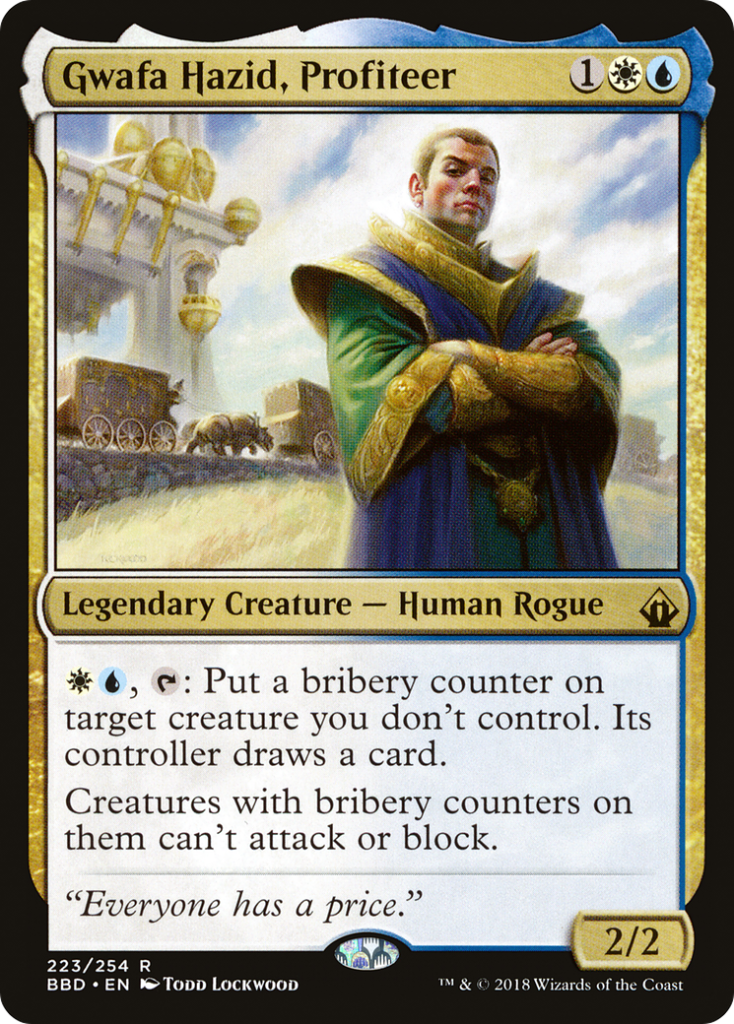
Gwafa is a three mana 2/2 that for blue and a white and tap, you put a bribery counter on target creature we don’t control and its controller draws a card and creatures with bribery counters can’t attack or block.
A strategy I haven’t really delved too deep into what’s known as the pillow fort strategy, which is a strategy where you amass a defense so difficult to deal with that your opponents can’t really attack you without expending a huge amount of resources while you work on an alternate win condition. The reason is I normally prefer more proactive strategies, but I also realize that there are people that do enjoy this strategy and want to do well by those people.
The name of the game is to put up enough ways to prevent our opponents from attacking us and amassing resources on our part to make sure we aren’t caught with our shields down.
The first thing that we need are the ideal ways to make sure that creatures don’t attack us.
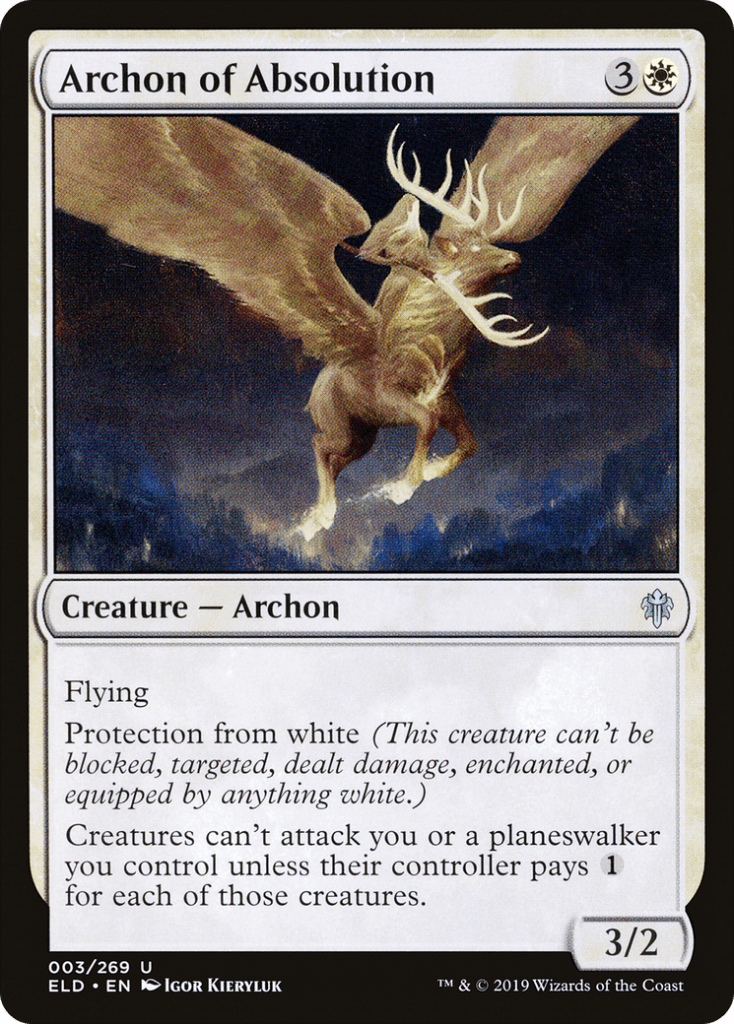
Archon of Absolution is a way to tax our opponents one mana for each creature attacking us or Planeswalkers we control, while also being a flying creature that has protection from white. This means it can deal with some number of flying threats while also being able to dodge some number of removal spells that happen to be white.
The classic examples of taxing creatures for attacking us are Ghostly Prison and Propaganda, both of which add a two mana tax for each creature to attack us, and there have been several variations of this effect seen.
Sphere of Safety adds an X mana tax for attacking creatures where X is the number of enchantments we control, Norn’s Annex adds a Phyrexian white tax to attacking creatures, and War Tax has an activated ability where we can pay X and a blue to prevent creatures from attacking unless they pay X for each attacking creature.
One of the better versions of this effect in my opinion comes from Archangel of Tithes, which has it so long as they are untapped creatures can’t attack us or Planeswalkers we control unless they pay one mana for each attacking creature, but as long as they are attacking, creatures can’t block unless they pay one mana for each of those creatures.
The next thing that we need are ways to make sure we establish some form of board presence in terms of creatures as well as gain advantage from our opponents doing things.
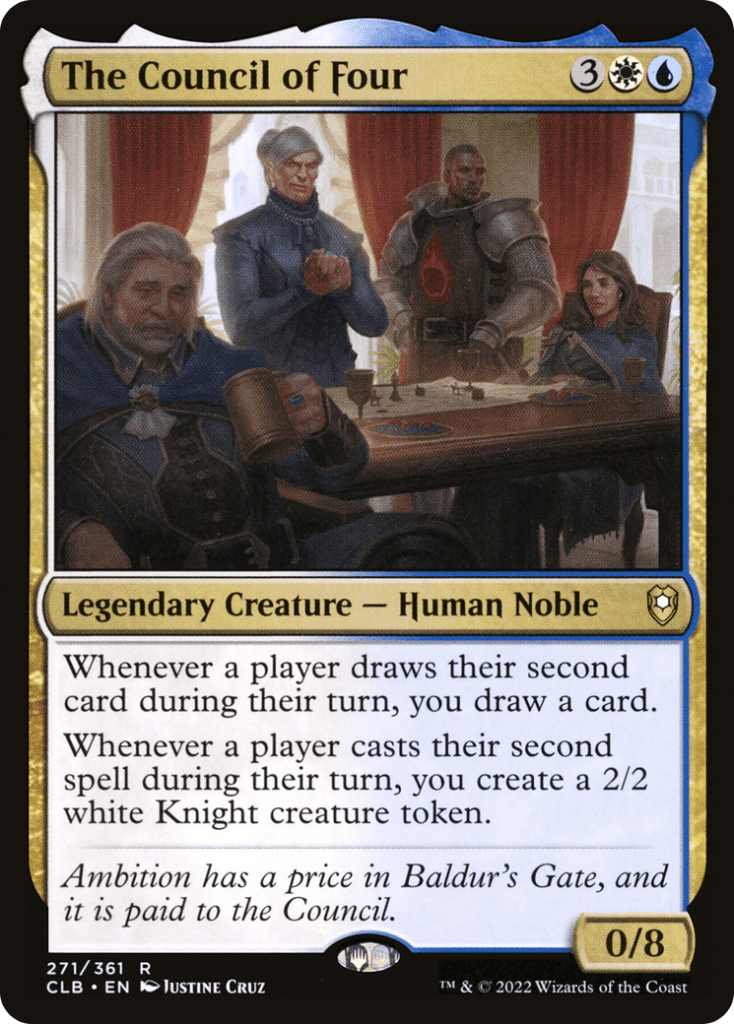
The Council of Four is solid for both aspects because whenever a player draws their second card during their turn we draw a card and whenever a player casts their second spell during their turn we make a 2/2 Knight creature token. This gives us some consistent card advantage while also making bodies for us to block anything that does manage to slip through to attack us.
Mangara, the Diplomat is also a good choice for us because whenever an opponent attacks us or Planeswalkers we control with two or more creatures draw a card and whenever an opponent casts their second spell each turn we also draw a card.
We can also incentivize our opponents into attacking each other by using Orzhov Advokist, which at the beginning of our upkeep each player may put two +1/+1 counters on a creature they control and if they do they, creatures that player controls can’t attack us or Planeswalkers we control until our next turn.
As another way to incentivize our opponents into attacking each other we can use Sokrates, Athenian Teacher, which has hexproof as long as they are untapped and can tap and give a creature “If this creature would deal combat damage to a plater, prevent that damage. This creature’s controller and that player each draw that many cards, rounded down.” until the end of the turn.
If we want to deal with any potential burn shenanigans, then we can use Michiko Konda, Truth Seeker which has is so whenever a source an opponent controls deals damage to us, that player sacrifices a permanent.
If we want to go on full denying our opponents from doing anything, we can use Fatespinner, which at the beginning of each opponent’s upkeep that player chooses draw step, main phase, or combat phase and then that player skips each instance of the chosen step or phase this turn. Since it says each instance of that phase, people will not likely want to give up both of their main phases and its doubtful many players will give up their draw step unless they have an insane draw engine, so most people would give up their combat step, ideally.
The last thing we need is a way to win, and while there are several ways we can win via alternate win conditions, I wanted to choose one that worked well with this sort of deck.
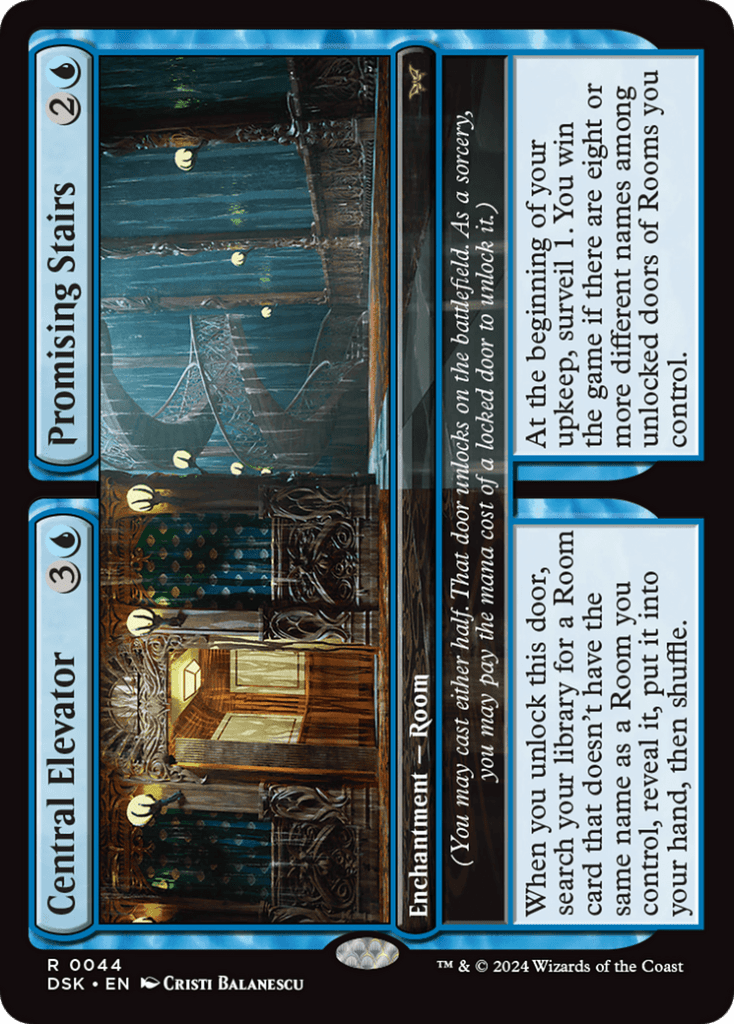
Rooms were a nice inclusion in Duskmourn, and they even came with a win condition in the form of Promising Stairs, which lets us surveil at the beginning of our upkeep but more importantly has it so if we control eight or more different names among unlocked doors of Rooms we control, we win the game. This win con is also facilitated by Central Elevator which let’s us tutor for a Room with a different name and put it into our hand.
There are several Rooms we can make use of to take slowly gain us advantages like Restricted Office and Lecture Hall which destroys all creatures with power 3 or greater and gives other permanents we control hexproof, Dazzling Theater and Prop Room to give our creature spells convoke and more importantly for Gwafa to untap our creatures during each player’s untap step, and Mirror Room and Fractured Realm to create a token copy of a creature we control except it is a Reflection in addition to its other types and a Panharmonicon effect for our permanents triggered abilities.
If we want to add a bit of combat pressure, we can use Dollmaker’s Shop and Porcelain Gallery, which makes a 1/1 Toy creature token whenever we attack with a non-Toy creature and then we can give our creatures power and toughness equal to the amount of creatures we control. Remember, Gwafa makes it so creatures can’t attack or block, meaning that if we put bribery counters on enough creatures we can get some pretty clean attacks in.
Gwafa as a Commander is more so a facilitator of a strategy rather than a direct engine or center piece of a strategy. Gwafa gives the idea to play more into a pillow fort strategy which allows you to accumulate resources until you advance to the alternate win condition of your choice.
The issue that comes with these sort of strategies is that they are slow and non-interactive, which is the point of them but it can be a bit tedious to play with. Choosing cards that have more interaction with other players helps mitigate this, but if you go all in on the pillow fort strategy then you are in a box not really doing anything while everyone else does things.
One way to combat this is like I said, play more interactive pieces for the game. The reason I went with the Rooms win condition for this blog is to have some more pieces that did other things rather than sit and prevented our opponents from attacking us.
Gwafa makes it so a creature can’t attack or block, the number of which will build up slowly which is why we play the other attack tax pieces, but if we don’t interact and do some attacking of our own, then we just sit there and do nothing. We can make use of some of these big creatures to help us win the game rather than relying on an alternate win con to be our only win con.
Thank you for reading, see you tomorrow for the next Daily Commander!
Peace,
From, J.M. Casual




 J.M. Casual Blog
Leave a comment