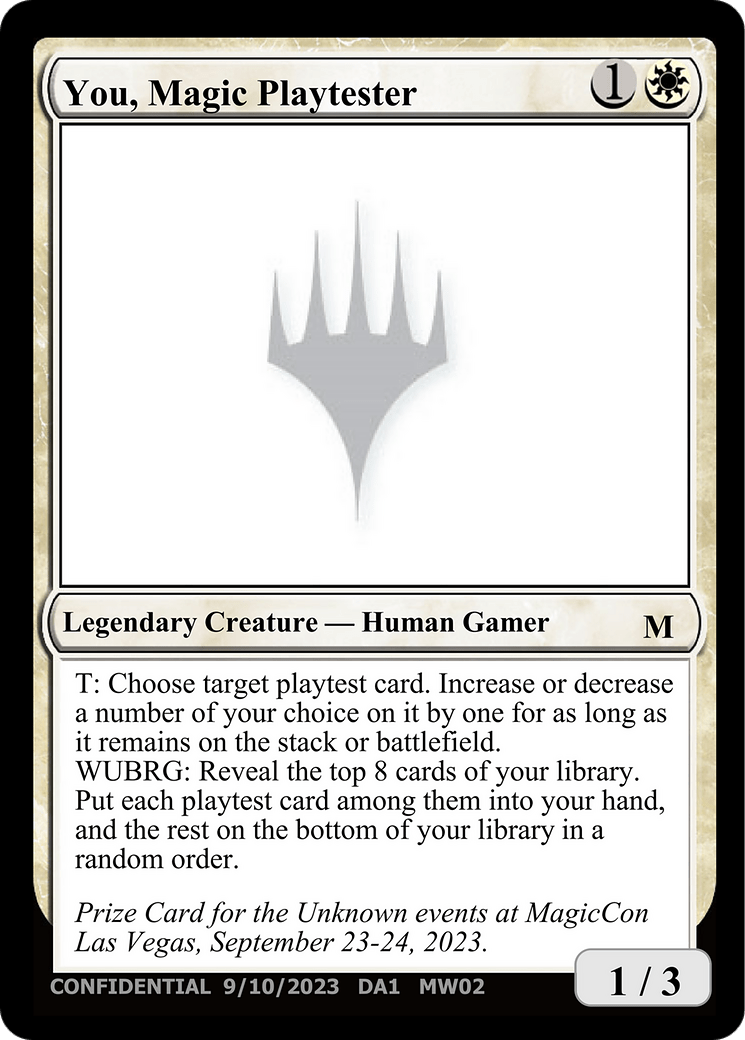
Hello and welcome to the Casual Chat!
Seeing that it is the end of the month, the Casual Chat is back with a topic that I am surprised I haven’t talked about, but is something that is very important when designing not just card games, but any sort of game in general.
That is playtesting, and we’ll talk about what it is, what the purpose of playtesting is, and some of the things that playtesting does well and where there are cracks.
Let’s get started!
What is Playtesting?
For those unaware, playtesting is very much in the name, we play a game to test it out to make sure that the game functions as intended.
The idea is to make sure that all the gears are turning and nothing immediately breaks when you play your game, and that the game is fun to play in the first place.
For example, if you are making a brand new game and think its fun to do one thing, rather than immediately keep it as a core mechanic of the game, you test it out a few times to make sure that it is actually fun to play with.
If the mechanic is fun to play with and doesn’t break the game then you have something you can work with, but if it doesn’t do either then it could be back to the drawing board.
Or if you happen to be working on a game that already exists and has an expansion of some form being made, you can bring out a mechanic that you think would be fun and see how well that mechanic happens to work with an already existing machine.
Balancing
As someone who is in the habit of making custom Magic cards, I often see other custom Magic cards and see that there are some common pitfalls that people make when making new cards, one of them being how a card is templated doesn’t technically work within the rules of the game or would break the game in half if it was a real card.
That is where playtesting also helps, it helps control the power levels of a game, whether it is a new game or an old one. If you understand the power level of the game you’re making, then you can use playtesting to make sure that something doesn’t go off the rails.
if you have something that draws you eight cards and it is the only way to draw cards in your game, then that card may be too strong. However if you have a card that draws you eight cards and there are other cards that draw you a ton of cards, then that card could be perfectly fine.
Every card has a series of levers and knobs to move in order to get the power level just right, and it may be something as making it cost more or less, raise or lower its combat abilities, or giving it a cantrip effect that can make a boring card feel good to play.
Rough Patch
The thing that most people won’t tell you about playtesting is that it can be pretty miserable.
Sure, you are playing games all day and it may be your very first game and you are excited to play it, but when you make your first draft of your game along with the earliest iteration of your rules, it’s going to be pretty rough.
Not every game is perfect off the jump, and there are going to be a ton of rough patches when playtesting. Maybe a core mechanic of your game is actually bogging things down, or your playtesters find an infinite combo that you didn’t see when you were designing the cards, or you realize that one card is significantly better than the other cards and no one else want to play those other cards, something will go wrong.
Mark Rosewater, Head Designer for Magic has said numerous times on his podcast Drive to Work that he has played a ton of bad games of Magic when playtesting, because not all the cards work as the designers want them to work.
This however can lead to one of the more interesting aspects of playtesting.
New Solutions
Sometimes a mechanic for a game isn’t working, but isn’t so bad that it isn’t causing problems, it can mean that the mechanic may just need a bit of a tweak to get working.
Sometimes adjusting a mechanic slightly or how a card interacts with a mechanic may change the entire perspective of a card and how people may enjoy the mechanic.
To go back to Mark Rosewater’s podcast Drive to Work, I remember him telling an anecdote of the card Ulamog’s Crusher and how despite it having Annihilator which triggers when that creature attacks on a common creature, people weren’t attacking with it because it cost eight mana and they didn’t want to get it removed.
The solution? Make it so that the creature must attack each combat if able. That way people could get the game going without stalling, they would then see how strong the Annihilator mechanic was, and show that the format favored big things overall.
There was also an anecdote for Innistrad where they wanted a way to symbolize how Werewolves would work and after several attempts the idea for double faced cards came to be as a potential solution that managed to work within the rules and tested well enough that it eventually became a main stay mechanic for the rest of Magic.
Playtesting is where you can get creative with how your game works, bending the rules to make things work if necessary while finding creative solutions to potential issues that may come up.
Slip Through the Cracks
This doesn’t mean that playtesting is perfect however.
Playtesters may be able to find a decent chunk of issues with the game that you’re making, but they are human and you only have so many people and so much time allotted for playtesting your game that a mistake may end up slipping without you or the playtesters realizing it.
It also comes to the fact that the player base of a game is going to outnumber the designers and playtesters by a significant margin, and with how fast information spreads nowadays, people can find issues that may have been overlooked or not even considered.
The famous example for Magic is Skullclamp, which originally gave +1/+1 and when equipped creature dies draw two cards, and was changed late in development to be +1/-1 with the same draw effect thinking that there would be no harm in it. Instead, it became so good it needed to be banned in several formats.
As a more recent example of this is Nadu, Winged Wisdom, which was a Modern Horizons 3 card that was designed to be played more in Commander, ended up being way to strong for both Modern and Commander in a way that it became banned in both of those formats.
In Conclusion
Game designers and playtesters are people, and mistakes will happen no matter how much time you give to playtest a game. The purpose of playtesting is to see if the game is fun to play and doesn’t break anything, and sometimes things will slip by.
Sometimes a mechanic or game piece is way too strong that a heavy adjustment or ban is needed, and other times something that looks way too strong ends up not being played at all.
As with all aspects of game design, there needs to be a delicate balance of what to expect from your playtests and to make sure that if you are playtesting a game, set realistic expectations.
Perfect is the enemy of good, which is to say that the more you strive for something to be “perfect” then it will never be “good enough” to have people play. Playtesting will reveal holes in your game, and while you should fix the biggest holes, sometimes small ones give your game a bit of charm.
Just make sure to keep an eye on it before it gets bigger.
Thank you for reading, see you next time!
Peace,
From, J.M. Casual
Bluesky: @jmcasualnerd.bsky.social
Ko-Fi: ko-fi.com/jmcasual


 J.M. Casual Blog
Leave a comment